
S$191K Passive Income, S$25K Living Cost: The Southeast Asia FIRE Equation
My portfolio pays me roughly S$191,000 a year.
Meanwhile, a normal expat life in Kuala Lumpur, Ho Chi Minh City or Bangkok costs around S$25,000 to S$27,000.
Those two numbers should not sit comfortably in the same sentence.
Yet they do, and that gap is the entire case for Southeast Asia FIRE.
Let me be clear about one thing first.
My capital is not going anywhere.
The portfolio stays in Singapore dollars, and it keeps working where it works best.
Only my lifestyle base is in play.
So I ran the numbers on three cities.
I compared living costs, market risk, the macro backdrop and daily liveability across KL, HCMC and Bangkok.
However, I did not end up with a ranking.
Instead, I ended up with a better way to think about early retirement.

Dating Redpill
Dating
The FIRE Equation Most People Forget
Classic FIRE is a two-variable problem.
You take a portfolio, apply a withdrawal rate, and the product becomes your annual budget.
Then you spend a decade arguing online about whether 4% is reckless.
That equation hides a third variable, though: what the budget actually buys.
A dollar of passive income is not a fixed unit of life.
In Singapore, S$120,000 a year is comfortable.
In Kuala Lumpur, the same money places you in a different category of existence.
Importantly, nothing about the portfolio changed. Only the postcode did.
In other words, geography is not a lifestyle footnote.
Geography is a financial lever, and for most people it is the biggest lever they never pull.
My Real Southeast Asia FIRE Numbers
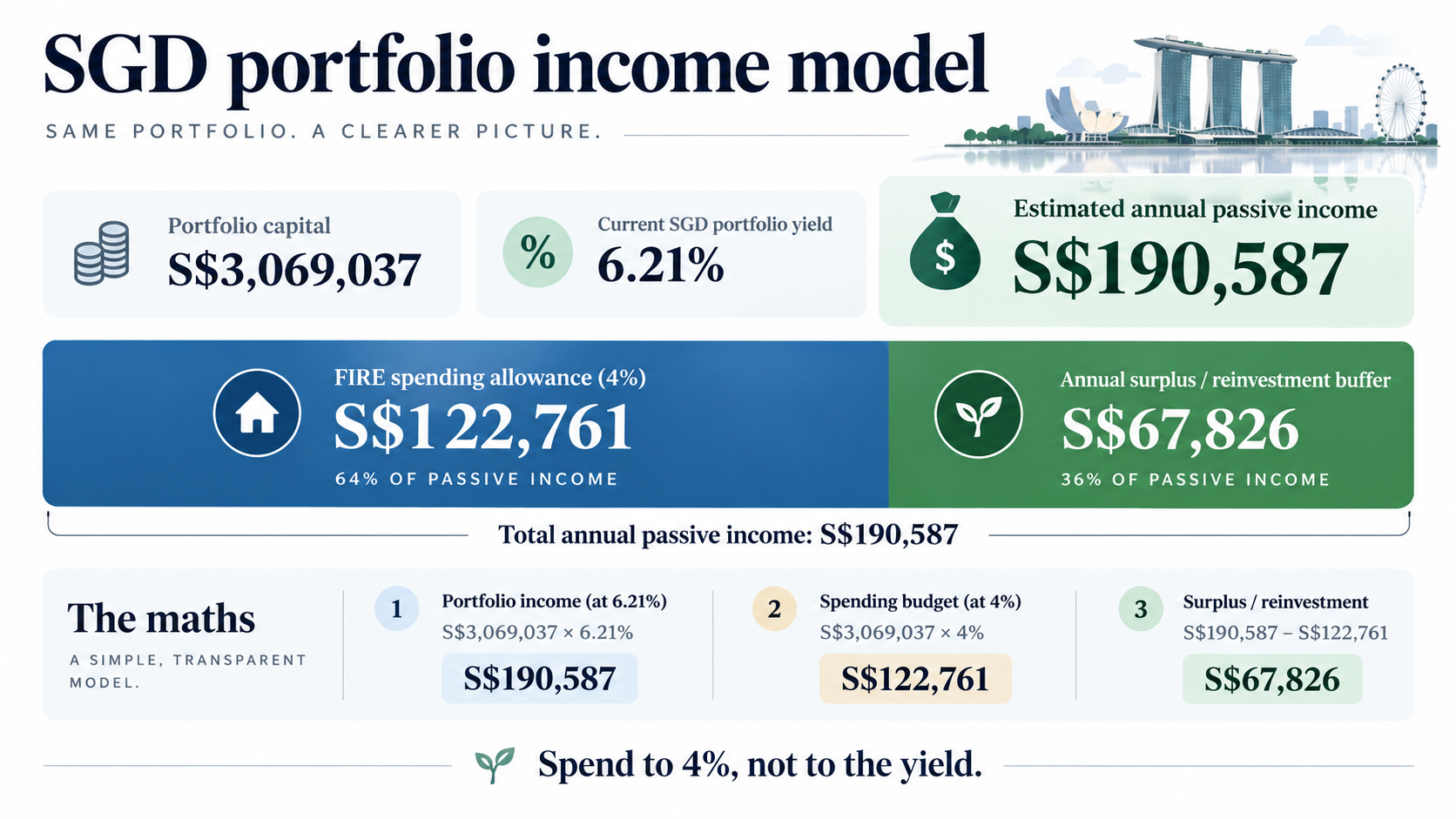
The arithmetic runs like this:
- S$3,069,037 × 6.21% = S$190,587 passive income
- S$3,069,037 × 4% = S$122,761 spending budget
- S$190,587 − S$122,761 = S$67,826 surplus
Notice the deliberate choice.
I do not plan to spend the full yield.
Instead, I cap spending at a conservative 4% of capital, even though the portfolio currently pays considerably more.
That S$67,826 gap does real work.
It absorbs dividend cuts, bad years and my own occasional lapses in judgement.
Moreover, it keeps compounding quietly in the background.
Yields fluctuate. Spending discipline is the part I control.
Where the Extra Capital Came From
In May, this portfolio stood at S$2.03M.
Since then, I sold my District 10 property near Robin Drive and redeployed roughly S$1.04M of the proceeds into the same SGD income engine.
You can read that earlier breakdown in my post on the S$2M dividend portfolio funding five countries.
Notice what that transaction actually did.
Prime Singapore freehold is a superb store of value, yet it is a poor source of cash flow.
A property yielding 2 to 3% gross, before maintenance, property tax and vacancy, does not fund a life.
The same capital sitting in Singapore banks and REITs does exactly that.
I did not leave Singapore.
I changed the form my Singapore capital takes.
The bricks became cash flow, and cash flow is what buys geography.
Important: S$25K Is Not My Personal Spending
This is where readers usually misread the headline, so let me be precise.
The S$122,761 is my spending allowance.
It is not my forecast cost of living.
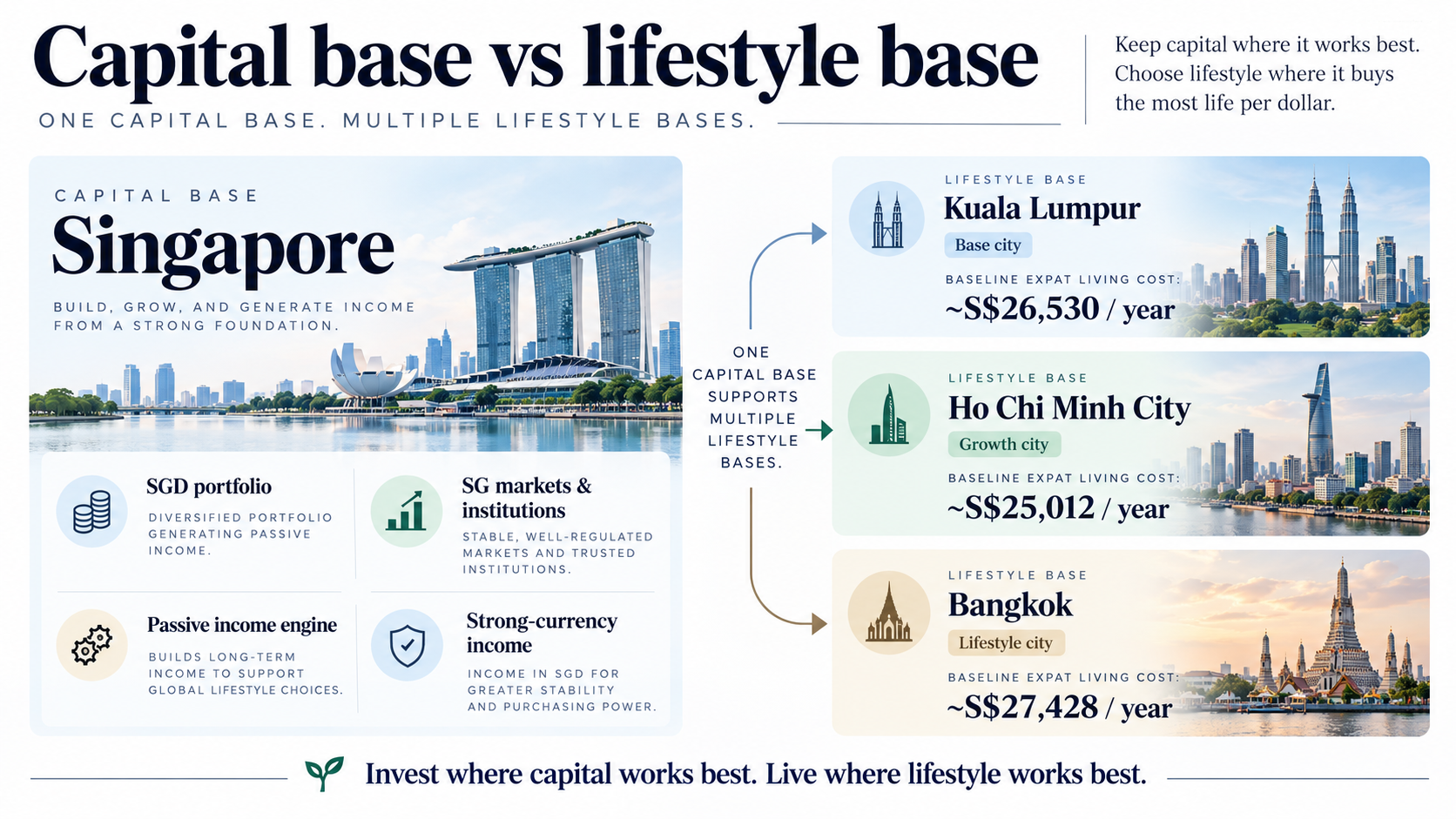
In contrast, the S$25K to S$27K figures represent baseline expat living costs: a median-ish, reasonably comfortable, city-centre life for a renter.
Here is what each baseline assumes.
Kuala Lumpur: ~S$26,530 a year. City-centre 1BR at roughly RM3,500 a month, a Grab-heavy lifestyle, utilities, food and groceries, gym and daily expenses.
Ho Chi Minh City: ~S$25,012 a year. Central 1BR at roughly VND25m a month, Grab-heavy, plus utilities, food, gym and daily expenses.
Bangkok: ~S$27,428 a year. Sukhumvit living at roughly THB30,000 a month, more BTS and MRT with some Grab, plus utilities, food, gym and daily expenses.
What these baselines leave out matters just as much.
Travel, flights, dating, fine dining, nightlife, private healthcare, insurance and family support all sit outside the number.
For reference, you can sanity-check the broad ranges yourself on Numbeo.
My own KL setup looks nothing like a baseline, either.
I keep a condo near TRX and drive a performance car, and those fixed commitments run to roughly S$3,698 a month before I buy a single meal.
That sits well above a renter’s baseline, and it is entirely a choice.
That is the real point.
The fixed cost base is low enough that lifestyle becomes a choice rather than a financial constraint.
When the non-negotiables consume a fraction of your allowance, everything above that line becomes optional.
Consequently, your financial life stops being defence and becomes a menu.
Why Southeast Asia FIRE Separates Capital From Lifestyle
This is the most important idea in the article, so I will state it plainly.
Where capital is invested and where lifestyle is consumed are two separate decisions.
Most people merge them.
They assume that moving to Malaysia means investing in Malaysia, or that retiring in Thailand means betting on Thai equities.
As a result, they end up judging a city as though it were a stock, and a stock as though it were a city.
I keep the two apart.
My passive-income engine stays SGD-based, anchored to Singapore’s markets and institutions.
Meanwhile, my lifestyle base sits wherever it delivers the most life per dollar.
Think of a company with a treasury and a field office.
The treasury stays in the jurisdiction with the strongest currency and the deepest capital markets.
Operations run wherever costs and conditions suit the work.
No sensible CFO relocates the treasury simply because the factory moved.
Invest where capital works best. Live where lifestyle works best.
This separation carries a quiet structural advantage too.
Income arrives in a strong currency, while costs land in weaker ones.
Effectively, you stay long SGD against your own cost of living.
That trade will not always move your way.
Nevertheless, it beats earning and spending in a currency you do not trust.
KL, Bangkok and Ho Chi Minh City: Three Cities, Three Jobs

I did not set out to crown a winner.
Instead, each city turned out to suit a different kind of person.
KL: The Base City
Kuala Lumpur is the balanced option.
City-centre living remains relatively cheap, the macro picture looks healthy, and its equity market is the least volatile of the three.
Moreover, it sits close to Singapore, feels culturally familiar and runs smoothly on Grab.
For a base city, those traits matter more than glamour.
You can fly home in about an hour, most systems work, and the learning curve stays gentle.
The weakness shows up on the investment side.
Malaysian equities were the weakest 10-year performer among the three markets I studied.
That is precisely why the separation principle matters.
A country can be a great place to live even if it is not the best place to invest. KL works as a lifestyle base while your capital stays in Singapore.
Ho Chi Minh City: The Growth City
HCMC carries the lowest baseline cost of the three alongside the fastest-growing economy.
Its market also shows the lowest correlation with Singapore, so it moves to its own rhythm.
Nevertheless, it is the most volatile market of the three, runs the highest inflation, and brings more administrative friction.
Paperwork moves slowly, rules shift, and things break more often.
Some people see a dealbreaker there.
Others see the appeal.
HCMC gives you more growth, more energy and more chaos.
If you want a city that still feels unfinished in an exciting way, this is it.
Bangkok: The Lifestyle City
Bangkok offers the best urban convenience of the three.
Sukhumvit living is excellent, the BTS and MRT network is genuinely usable, and the food and service ecosystem is hard to match anywhere in the region.
It does cost slightly more.
The baseline is the highest of the three, and the macro backdrop looks softer.
Bangkok public transport also costs more per ride than KL’s.
However, its last-mile usability is generally better, especially along Sukhumvit, where you can run most of your life within a few stations.
One note for long-time readers.
In May I called Bangkok cheaper than KL.
That comparison set my car-owning KL life against a carless Bangkok stint.
On a like-for-like renter’s basket, Bangkok comes out marginally higher.
Bangkok charges you a little more, yet gives you more convenience in return.
Why I Still Checked Markets I Am Not Investing In
A fair question follows.
If my capital stays in Singapore, why analyse these markets at all?
Because I may live in these economies, and I want to understand what I am living in.
I am not studying these numbers because I intend to move my portfolio there.
I am using them as a health check on the economic environment I may live in.
A shaky economy reaches your daily life long before it touches your portfolio.
It shows up in supermarket prices, rents, currency swings, public services and general stability.
Therefore, the market data serves as a diagnostic rather than a buy signal.
I used three country ETFs as proxies: EWM for Malaysia, VNM for Vietnam and THD for Thailand.
For the Singapore benchmark, I used EWS, which tracks the market I actually invest in through the SGX.
Correlation: Does It Move Like Singapore?
Correlation measures how closely two markets move together.
A higher number means the market behaves more like Singapore’s.
A lower number means it moves more independently.
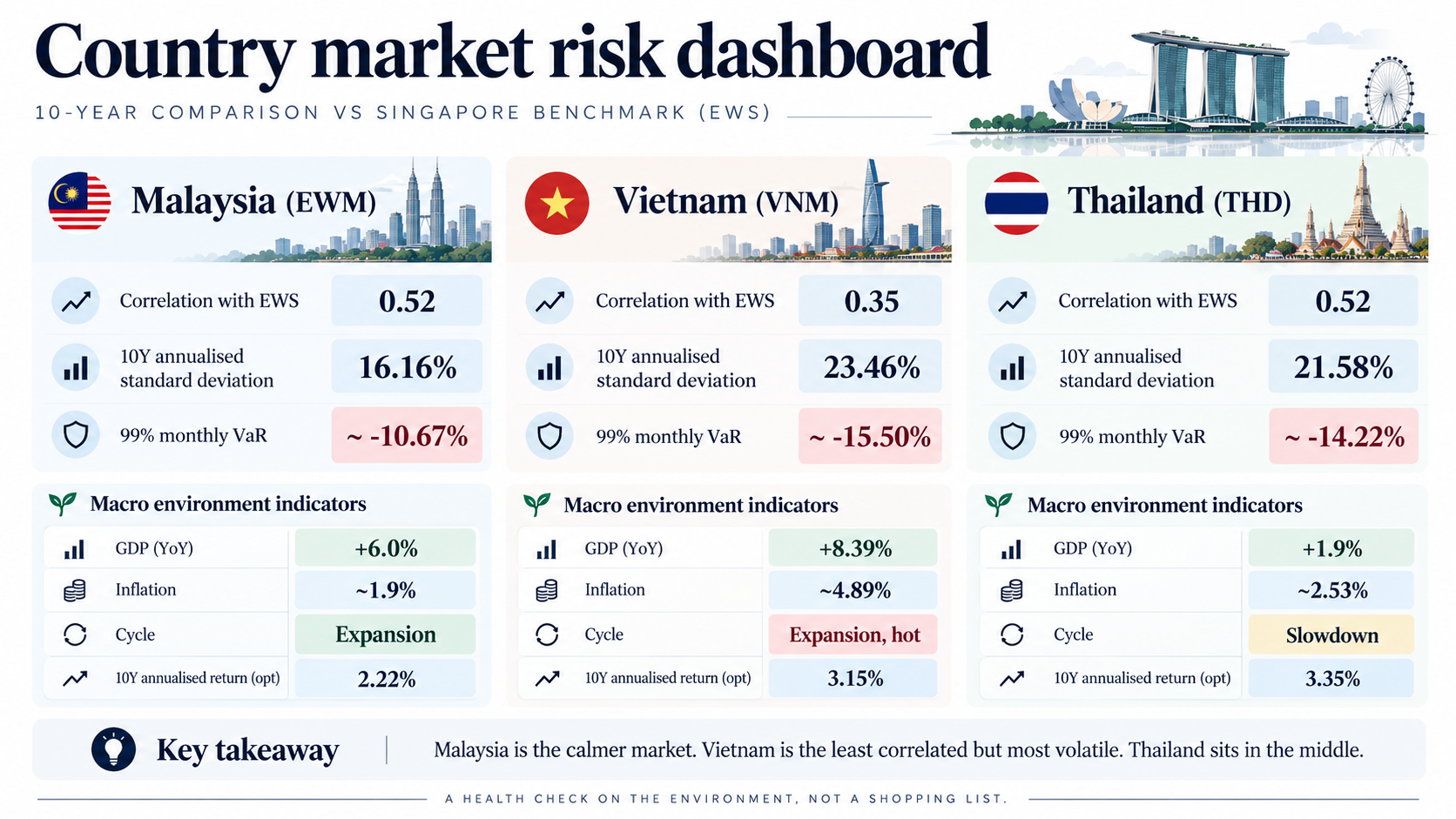
I used a 10-year Pearson correlation of monthly returns against EWS:
- Malaysia (EWM): 0.52
- Vietnam (VNM): 0.35
- Thailand (THD): 0.52
Why a fixed decade instead of full history?
Because each ETF launched on a different date, so full-history figures would compare different market periods.
Similarly, it resembles comparing two drivers’ safety records when one drove through a monsoon and the other did not.
A fixed window delivers a clean apples-to-apples comparison, and monthly returns filter out much of the noise that daily data carries.
Vietnam is clearly the most independent of the three.
However, lower correlation does not automatically mean safer or better.
It simply means different.
After all, a market can zig when Singapore zags and still lose money in both directions.
Volatility and VaR: How Rough Is the Ride?
| Country | 10Y annualised return | 10Y annualised std dev | 99% monthly VaR |
|---|---|---|---|
| Malaysia (EWM) | 2.22% | 16.16% | ~ −10.67% |
| Vietnam (VNM) | 3.15% | 23.46% | ~ −15.50% |
| Thailand (THD) | 3.35% | 21.58% | ~ −14.22% |
Standard deviation measures how widely returns swing around their average.
The higher it climbs, the bumpier the ride.
VaR, or Value at Risk, is simpler than it sounds.
It estimates how ugly a statistically bad month could get.
Vietnam’s 99% monthly VaR of about −15.5% means roughly one month in a hundred should bring a loss that size or worse.
The pattern reads clearly.
Malaysia is the calm one, while Vietnam and Thailand earned slightly more with far more turbulence.
Notably, none of the three produced returns that would tempt anyone away from an SGD income portfolio.
Macro: Where Is Each Economy in the Cycle?
| Country | GDP (YoY) | Unemployment | Inflation | Cycle |
|---|---|---|---|---|
| Malaysia | +6.0% | ~3.0%, flat | ~1.9% | Expansion |
| Vietnam | +8.39% | ~2.23% | ~4.89% | Expansion, hot |
| Thailand | +1.9% | ~1.00% | ~2.53% | Slowdown |
Malaysia looks healthy, combining solid growth with tame inflation.
Vietnam runs fast, although inflation near 5% is the price of that speed.
Thailand, meanwhile, works through a slower patch.
For a resident rather than an investor, inflation matters most.
Your income stays fixed in SGD, so local inflation quietly erodes what it buys unless the currency moves to offset it.
Valuation: Are You Paid for the Drama?
| ETF P/E | Earnings yield | 20Y bond yield | Spread | |
|---|---|---|---|---|
| Malaysia | 15.31x | 6.53% | 4.35% | 2.20% |
| Vietnam | 13.08x | 7.65% | 4.80% | 2.84% |
| Thailand | 17.10x | 5.85% | 3.14% | 2.71% |
Earnings yield is the P/E flipped upside down.
It tells you how much profit you buy for every dollar you pay.
For example, a P/E of 13x works out to roughly 7.7% of earnings per dollar invested.
The spread compares that earnings yield against a long-dated government bond, which approximates the equity risk premium.
That premium is the extra reward for owning riskier shares instead of safer bonds.
If equities offer only a slim yield advantage over government bonds, you take on more drama for not much extra reward.
Vietnam offers the widest cushion here.
Thailand’s spread looks respectable, although mostly because its bond yields sit low, and low yields often signal weaker growth expectations.
Malaysia offers the thinnest premium of the three.
Again, these figures work as country-environment indicators, not portfolio instructions.
They describe the weather where I might live.
They do not tell me where to plant the orchard.
The Mistake: Optimising Everything Except Geography
Here is the part of FIRE culture I find genuinely strange.
Investors will argue over 50 basis points of ETF fees for hours, then casually choose to live in a city that costs tens of thousands more per year.
They rebalance obsessively, debate accumulating versus distributing share classes, and build spreadsheets chasing a 0.2% difference in expense ratios.
Afterwards, they default to living wherever they happen to be, without ever pricing that decision.
On a S$1M portfolio, 50 basis points equals S$5,000 a year.
In contrast, the gap between an expensive global city and a well-chosen Southeast Asian base can dwarf that several times over.
That is not optimisation.
Rather, it is precision on the small variable and blindness on the big one.
Location is a line item, and it deserves at least as much scrutiny as your asset allocation.
Southeast Asia FIRE Is an Arbitrage Stack
The cleanest way to understand Southeast Asia FIRE is as several arbitrages layered on top of each other.
Income arbitrage:
Invest in a stronger currency and a deeper market.
For me, that means an SGD portfolio anchored in Singapore’s stability and governance.
Cost arbitrage:
Spend where the same standard of living costs a fraction of the price.
Rent, transport, food and services all cost less.
Lifestyle arbitrage:
This one stays underrated.
Lower costs do not merely mean spending less.
Instead, they mean getting more: a better apartment, more help, more dining out, more travel, more time.
What rises is not just savings per dollar, but life per dollar.
Geographic optionality:
Finally, nothing locks you in.
If KL stops working, try Bangkok.
If Bangkok gets expensive, try HCMC.
Because your capital is not tied to any one country, relocating becomes a lifestyle decision rather than a financial restructuring.
Few people price that in, although it may be the most valuable arbitrage of the four.
Scale the Model to Your Own Portfolio
To be clear, you do not need S$3M to make geographic FIRE work.
My number is a case study, not a price of entry.
Here is the same 4% logic at different portfolio sizes:
| Portfolio | Spending at 4% |
|---|---|
| S$1,000,000 | S$40,000 a year |
| S$1,500,000 | S$60,000 a year |
| S$2,000,000 | S$80,000 a year |
| S$3,000,000 | S$120,000 a year |
Now set those against the baselines.
Even at S$1M, a S$40K budget sits roughly S$12,500 to S$15,000 above the baseline in all three cities.
That cushion is thin, although it is real.
At S$1.5M to S$2M, the baseline becomes a minority of your budget and discretionary life opens up.
So plug in your own figures.
Take your portfolio, apply a withdrawal rate you trust, and subtract each city’s baseline.
What remains is your freedom margin.
My own number sits at S$3.07M, which puts the allowance at S$122,761.
Use whatever your actual number happens to be.
The model does have edges, of course.
Visas, healthcare, insurance, tax residency and currency moves all demand individual attention, and they vary with nationality and circumstances.
Therefore, treat the baseline as a floor to build on rather than a complete budget.
Cheap Is Not the Goal
This is where “retire cheap in Asia” content gets it badly wrong.
The objective is not minimising spending.
Anyone can live cheaply almost anywhere by lowering their standards far enough.
That is endurance, not strategy.
The goal is to live disproportionately well relative to the capital required.
That distinction changes how you choose.
You stop asking where things cost least and start asking something sharper.
The real question is not “Which country is best?”
It is “Which country gives me the best combination of cost, quality of life, convenience and financial margin of safety?”
If you value stability and proximity to Singapore, the answer might be KL.
If you want energy and tolerate friction well, it might be HCMC.
If convenience and urban lifestyle come first, it might be Bangkok.
None of those answers is wrong.
What matters is choosing deliberately, with numbers, instead of by default.
Final Takeaway: Rethinking Southeast Asia FIRE
Most FIRE planning treats geography as a given.
Geography is not a given, though.
It is a variable, and often the most powerful one available to you.
My portfolio stays in Singapore dollars, doing what it does best.
Meanwhile, my lifestyle base can sit wherever that capital buys the most life.
The S$191K versus S$25K gap is not a trick.
Rather, it is simply what happens once you stop treating where you invest and where you live as a single decision.
That is the real lesson of Southeast Asia FIRE.
The point is not that Asia is cheap.
The point is that capital and lifestyle do not have to share an address.
Traditional FIRE asks:
“How much do I need to retire?”
Geographic FIRE asks a better question:
“Where can my existing capital buy the life I actually want?”
This article reflects my personal case study and is not financial advice. Market and cost figures are estimates as at October 2026.