
Why Smart Singaporean Men Overpay for Health Screenings (It’s Not About Quality)
Medical Tourism Arbitrage KL vs Singapore
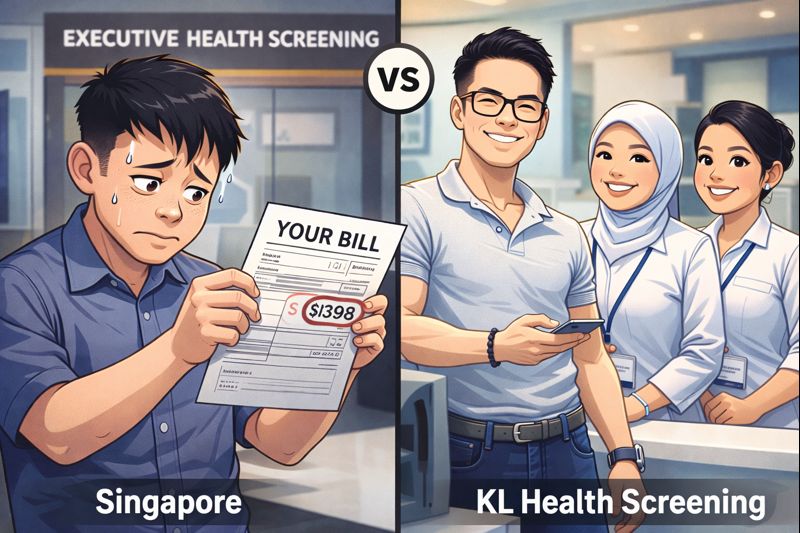
Most Singaporean men assume paying S$300–400 for a “comprehensive” health screening is normal.
That assumption, however, quietly drains your wallet every single year.
In reality, the higher price has little to do with better medicine.
Instead, it reflects branding, cost structure, and how healthcare systems are designed.
Because of that, many men unknowingly overpay for routine blood work.
This is exactly where medical tourism arbitrage KL vs Singapore becomes obvious.
Dating Redpill
Dating
What “Comprehensive Blood Screening” Really Means
Before comparing prices, we need clarity.
A mid-range, blood-heavy screening usually includes:
-
Full Blood Count (FBC)
-
Kidney and liver profiles
-
Lipids and diabetes markers
-
Uric acid
-
Thyroid (TSH)
-
Urine FEME
-
Hepatitis B markers
-
Vitamin D
-
hs-CRP
-
Basic tumour markers (AFP, CEA, CA 19-9)
In Singapore, this is often labelled “Executive” or “Plus”.
In Kuala Lumpur, it is labelled “Clinic-level” or “Comprehensive Blood Panel”.
Same blood.
Same machines.
Same ISO-accredited labs.
Different price tags.
The Price Gap Nobody Wants to Explain
Kuala Lumpur (TRX / Klang Valley)
In Kuala Lumpur, a Sapphire-style 43-test blood panel typically costs RM190, which is about SGD60.
Across the Klang Valley, similar clinic-level packages usually fall between RM150–300.
As a result, even hospital-based “core” packages with consultations and basic imaging often remain below RM800.
For most healthy men, that already covers what an annual screening should achieve.
Singapore (Private Clinics & Hospitals)
In contrast, Singapore packages with a similar blood-test scope are priced very differently.
Most private hospitals and branded screening centres charge between S$250–400.
Although budget GP packages exist, they often exclude thyroid tests, Hep B screening, vitamin D, or tumour markers.
Because of that, truly comparable panels usually sit in the higher price range.
This difference highlights the core of medical tourism arbitrage KL vs Singapore.
Side-by-Side Reality Check
| Location | Package Type | Approx Price |
|---|---|---|
| KL Clinic (Blood-only) | Sapphire-style 43 tests | ~S$60 |
| KL Hospital Core | Blood + ECG/X-ray | ~S$82 |
| SG Hospital Basic | Blood + urine + ECG | ~S$248 |
| SG Private Executive | Blood + tumour markers | ~S$319–398 |
That’s a 4–7× difference for similar blood data.
Why KL Is Cheaper (And It’s Not Quality)
Lower Operating Costs
First, operating costs in Malaysia are significantly lower.
Doctor and staff salaries, for example, are a fraction of those in Singapore.
Additionally, rent, utilities, and lab overheads cost less.
As a result, clinics can price screenings competitively while staying profitable.
Currency Arbitrage
More importantly, currency plays a major role.
Because the ringgit is weaker than the Singapore dollar, RM190 converts to just over S$60.
Therefore, a package priced normally for locals appears extremely cheap to Singaporeans.
This is purchasing power, not inferior medicine.
Medical Tourism Strategy
Beyond costs, Malaysia actively promotes healthcare as an export industry.
Government incentives and international accreditation support this positioning.
In comparison, Singapore focuses on premium tertiary care.
That difference alone explains much of the price gap.
The Smart Use Case for Singaporean Men
Here’s the optimisation play.
Use KL as your annual baseline lab hub:
-
Blood markers
-
Metabolic health
-
Liver, kidney, inflammation trends
Then use Singapore for escalation:
-
Specialists
-
Imaging
-
Complex diagnosis
-
Surgery or advanced intervention
This mirrors how high-level operators manage risk, cost, and optionality.
Not emotional loyalty.
Rational system use.
Tiering the Decision (So You Don’t Overdo It)
Blood-only (RM150–300)
Best for:
-
Ages 25–45
-
Asymptomatic
-
Fitness-focused
-
Annual tracking
Hospital Essential (RM300–450)
Best for:
-
Mild risk factors
-
Wants ECG or X-ray
-
One-stop visit
Executive / Premier (RM800–2,300)
Best for:
-
Age 40+
-
Known conditions
-
Corporate or insurance-driven needs
Most men don’t need Tier 3.
They just buy it because of branding.
Why Singaporeans Feel “Safer” Paying More
This is psychological, not medical.
Higher price signals:
-
Legitimacy
-
Authority
-
Reduced anxiety
However, blood biomarkers don’t become more accurate because they cost more.
Lab reference ranges are global.
Assays are standardised.
Machines are often identical.
The difference is perception, not precision.
Medical Tourism Arbitrage Is Rational, Not Cheap
Ultimately, medical tourism arbitrage KL vs Singapore is not about cutting corners.
Instead, it is about allocating money where it creates the most value.
By doing baseline blood work in KL, men reduce unnecessary spending.
Meanwhile, Singapore remains ideal for specialist care and complex follow-ups.
Because of this approach, high-agency men optimise both health and capital.
They do not rely on branding or fear.
They rely on systems.